
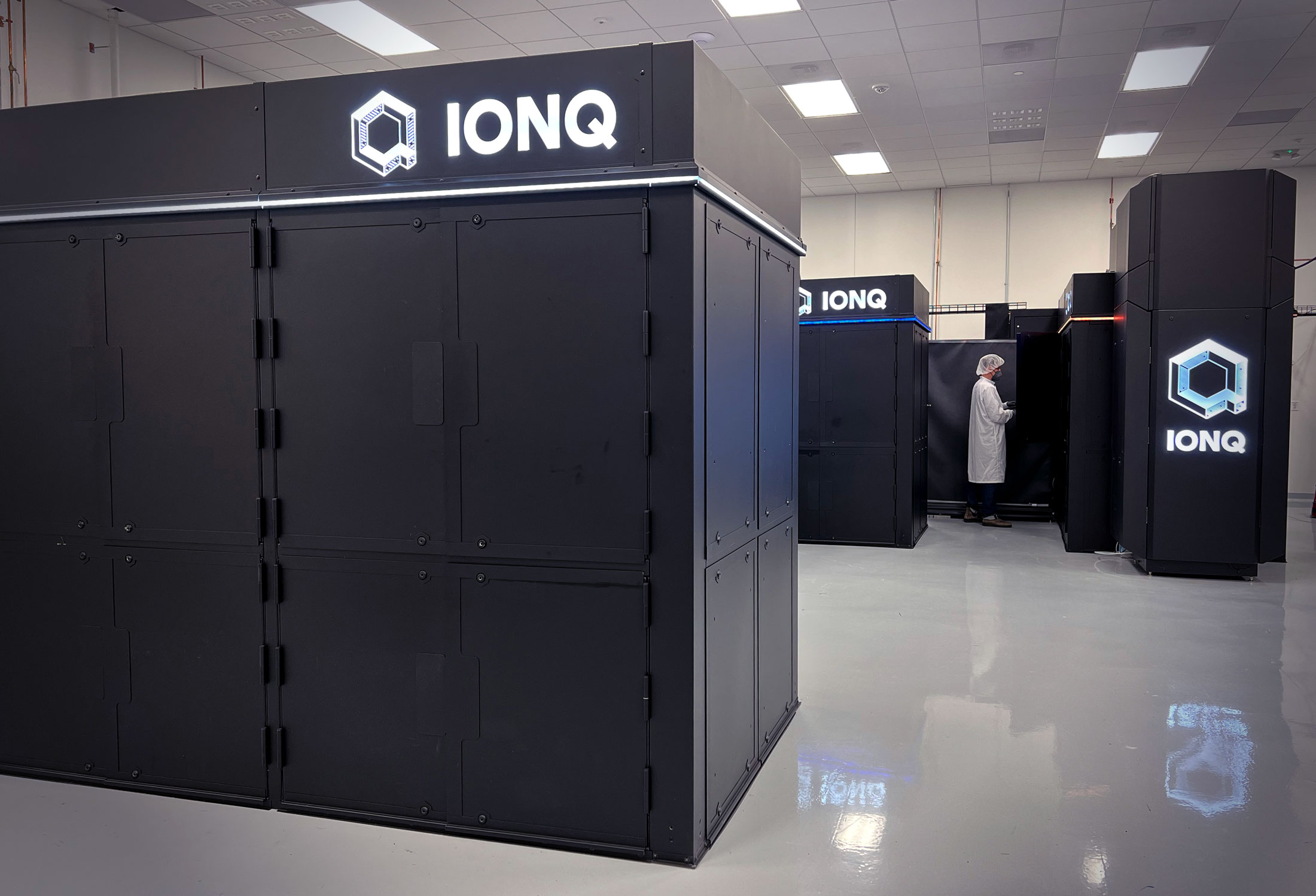
IonQ is one of the more interesting public ways to study whether quantum computing can become a real commercial market. It is also a company where a powerful roadmap can distract from the harder question. For me as a personal investor, the test is not whether quantum will soon transform every industry. It is whether IonQ can turn contracted demand, repeat customer deployments and a widening product set into repeatable revenue with improving economics.
That distinction matters because a quantum company can be technically ambitious, commercially early and expensive all at once. This is a research framework, not a recommendation to buy or sell IONQ.
What IonQ sells today
IonQ sells access to trapped-ion quantum computing systems, including through cloud providers, alongside systems and services aimed at enterprise and public-sector customers. The company is also building adjacent capabilities in quantum networking, sensing and security. Its current commercial proposition is therefore broader than a single future machine. Customers can buy access, deployments and related services while the company continues to develop its hardware roadmap.
The products should still be separated from the narrative around them. Hardware benchmarks and roadmap milestones can help explain why a customer might test a platform, but they are not independent proof of a durable commercial advantage. A useful investor question is whether a system leads to a paid deployment, then a repeat deployment, then a relationship that persists without an unusually large one-off project.
The evidence for commercialisation is improving
IonQ reported $80.1 million of second-quarter 2026 revenue, up 287% year on year. In its official Q2 results release, the company said commercial customers represented about 60% of quarterly revenue, international revenue about 50%, and multi-product revenue about 25%. Those are useful signs that demand is extending beyond a single customer type or geography.
The same release reported remaining performance obligations, or RPO, up 297% year on year. RPO is a useful leading indicator because it represents contracted work not yet recognised as revenue. It is not revenue, cash, a margin guarantee or proof that every contract will convert on the expected timetable. I would treat it as a queue to interrogate rather than a number to capitalise.
Commercialisation is not a roadmap event. It is the repeated conversion of customer interest into delivered work, cash collection and economics that improve as the business scales.
Revenue quality matters more than the headline growth rate
Rapid reported growth is encouraging, but it is not enough on its own. IonQ has made a series of acquisitions, so investors should separate organic quantum-computing demand from acquired revenue and revenue from newer adjacent businesses. Management described Q2 growth as organic in its release. The stronger evidence will be disclosed revenue mix, repeat deployments, retention, conversion of RPO into recognised revenue and cash, and a clearer explanation of what each acquisition contributes.
The Form 10-Q for the quarter ended 30 June 2026 reports $80.1 million of quarterly revenue and $60.1 million of cost of revenue, excluding depreciation and amortisation. That shows why gross margin deserves its own monitoring line. More revenue is valuable only if the company can deliver it without permanently expanding the cost base faster than gross profit.
There is a second discipline. One large contract can produce a striking quarter, particularly in a young market. The more durable pattern would be customers returning for additional systems, capacity, applications or related networking and security work. A healthy backlog should progressively become recognised revenue and operating cash flow, not just a longer list of announcements.
The manufacturing and vertical-integration proposition
IonQ completed its acquisition of Oxford Ionics in September 2025. According to the official completion announcement, Oxford Ionics adds patented trapped-ion technology manufactured using standard semiconductor chips. That could make the hardware architecture more compatible with scalable manufacturing. It is a credible strategic proposition, not yet proof that scale, yield or unit economics will work in practice.
On 31 July 2026, after the Q2 balance-sheet date, IonQ completed its acquisition of SkyWater Technology. The official closing announcement says SkyWater will continue as a U.S.-based semiconductor-foundry subsidiary, offering advanced technology, wafer and packaging services. In theory, the combination could bring chip design, fabrication, packaging and quantum-system development closer together.
The upside is a tighter learning loop, a more secure supply chain and potentially better manufacturing control. The risk is equally clear: the company could become an expensive collection of loosely connected technologies. Vertical integration is only an advantage if it improves product performance, cycle times, yield, customer delivery and eventually manufacturing economics. A larger organisational chart is not the same thing as a moat.
Liquidity is not profitability
IonQ had substantial liquidity at 30 June 2026, reporting $1.24 billion of cash and cash equivalents, $883 million of short-term investments and $840 million of long-term investments in its 10-Q. That gives management time to invest, but it does not remove the need for operating discipline. The same filing reports a $1.06 billion net loss for the first six months of 2026, including significant non-cash and valuation items.
A long runway can support ambitious research and acquisitions. It can also make it easier to postpone hard capital-allocation choices. I would therefore monitor cash burn separately from accounting losses, while taking neither lightly. The central question is whether incremental gross profit and commercial cash generation begin to cover more of the operating base before dilution or additional financing becomes the default answer.
Where I could be wrong
- Organic demand may be stronger than I expect. Repeat enterprise deployments and RPO conversion could demonstrate that quantum work is moving from experimentation into recurring operational spend faster than the financial statements currently show.
- The integrated stack may be more valuable than the segments imply. Oxford Ionics, SkyWater and IonQ’s software and networking capabilities could reinforce each other through faster development, manufacturing control and a better customer offer.
- I may understate strategic-customer value. Government, research and enterprise relationships can have longer purchasing cycles, but may create a base for follow-on programmes that is not visible in a single quarter.
- I may overemphasise near-term margins. Some investment is unavoidable in a technically demanding market. The important distinction is between purposeful investment with measurable commercial returns and open-ended spending protected by a strong balance sheet.
The risks I would not minimise
- Acquisition effects: reported growth can include acquired operations and integration timing, rather than representing organic demand for IonQ quantum-computing products.
- RPO conversion: contracted demand is not recognised revenue or cash, and its timing, margin and collectability matter.
- Architecture uncertainty: the eventual hardware and error-correction winner remains uncertain. IonQ competes with much larger, better-resourced companies as well as specialist quantum rivals.
- Losses and cash burn: substantial liquidity is valuable, but the business remains materially loss-making and needs a credible route to improving economics.
- Integration and capital allocation: rapid acquisitions can strain management, dilute focus and consume capital before synergies are demonstrated.
- Dilution: warrants, equity-funded deals and employee awards can increase the share count and change the claim of existing shareholders.
- Technical claims: company-reported benchmarks and roadmaps are useful inputs, not independent evidence of lasting commercial superiority.
My monitoring checklist
- Separate organic growth from acquisition-led revenue in each filing and results release.
- Look for repeat customer deployments, renewal evidence and a rising share of revenue from customers using more than one product.
- Track RPO against subsequent revenue recognition, cash collection and disclosed delivery timing.
- Follow gross margin, cost of revenue and operating cash burn, rather than focusing only on revenue growth.
- Read integration updates for Oxford Ionics and SkyWater, including retention of key people, product milestones and any evidence of manufacturing yield or cost improvement.
- Review whether foundry and packaging operations produce real manufacturing economics, not just strategic language.
- Update the fully diluted share count for warrants, acquisition consideration and employee equity awards.
Bottom line
IonQ is becoming more commercial in the straightforward sense that it is reporting larger revenue, broader customer exposure and more contracted demand. The more demanding thesis is still ahead of it. It must show that those signals convert into recurring, cash-generative revenue, better gross margins and a coherent integrated platform.
That is why I would judge the business through revenue quality, not just the roadmap. The Portfolio provides the broader context for my holdings. This article records the questions I would revisit as IonQ reports new information.
Disclosure: This article is for information and personal research only. It is not investment advice, a recommendation, or an offer to buy or sell any security. Quantum-computing equities are high risk and can be volatile. Primary sources considered include IonQ’s Q2 2026 Form 10-Q, FY2025 Form 10-K and official Q2 results release.