Monthly Portfolio Review: July 2026

July was a month of making the portfolio more honest about where my conviction actually sits.

This review uses my IBKR ISA only. It is the account represented by the main Portfolio page. My Trading 212 holdings are part of a separate £15k High Growth Challenge and are not included in the figures or commentary below.

The figures are from my IBKR prior-business-day-close snapshot for 31 July 2026. They are a dated record, not live prices or a recommendation for anyone to copy my allocation.

Portfolio snapshot

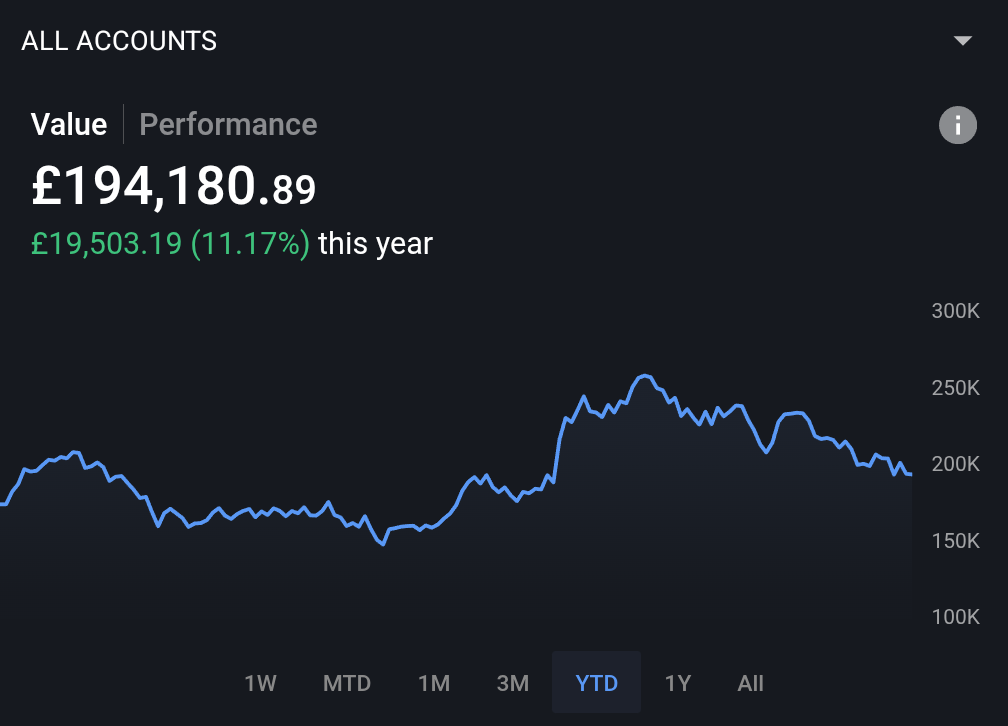
At the 31 July close, the IBKR ISA was worth £194,538.84, including £49.84 of cash. The invested value was £194,489.00.

The separate Trading 212 challenge was worth £12,132.13 at its 31 July snapshot, including £136.74 cash. I am keeping it separate because the two accounts use different reporting timings and serve different purposes.

The main portfolio remains deliberately growth-oriented and concentrated. That is not a claim that concentration is safe. It is an acknowledgement that my returns, good or bad, will be shaped heavily by a relatively small number of positions.

Biggest changes in July

The biggest decision was increasing my Rocket Lab position from 1,000 to 2,000 shares. To fund that change, I sold Apple, Alphabet, NVIDIA and SoFi, and reduced Uber in the IBKR ISA. I wrote separately about why I made Rocket Lab roughly 50% of my portfolio, including the concentration, financing and execution risks I am accepting.

I also increased Micron from eight to 10 shares and Surf Air Mobility from 10,000 to 13,800 shares. These are material changes to a concentrated portfolio, so I want them recorded rather than quietly absorbed into an evergreen holdings page.

No quantity changes were identified in the Trading 212 challenge between its late-July reporting snapshots. Its three holdings at month-end were Uber, Amkor and AST SpaceMobile.

Current main holdings at month-end

At the 31 July IBKR close, the core positions included:

  • Rocket Lab: 2,000 shares at $64.95.
  • Palantir: 250 shares at $123.06.
  • AbCellera: 3,001 shares at $5.71.
  • BETA Technologies: 1,000 shares at $18.93.
  • ServiceNow: 150 shares at $111.23.
  • Surf Air Mobility: 13,800 shares at $0.76.

Those prices are the values in the dated broker snapshot. The live Portfolio page is the better place for the latest IBKR ISA holdings and indicative GBP values.

What I am watching

Rocket Lab remains the central position to watch, partly because of its size and partly because the investment case depends on execution continuing across several moving parts. The opportunity is why I own it. The concentration is why I need to keep looking for evidence that could challenge my view.

I am also watching whether the smaller positions continue to earn their place. Owning a company is not a permanent vote of confidence. I need to be able to explain what I am underwriting, what has changed and what would cause me to reassess.

For AbCellera in particular, the clinical proof points remain important. My latest AbCellera investment update sets out why the next programme milestones matter to the thesis.

Where I could be wrong

The obvious risk is concentration. A few disappointing outcomes at the same time would hurt this portfolio materially. That is especially true when growth companies can be volatile, funding needs can change and expectations move faster than the underlying businesses.

Another risk is confusing familiarity with understanding. Spending time researching a company can improve a thesis, but it can also make a view feel more comfortable than it deserves. The job is to keep testing the assumptions, not just to keep repeating them.

Finally, a positive month-end snapshot does not settle anything. I want the monthly record to show the decisions, the uncertainty and the areas where I could be wrong, rather than turn every portfolio move into a victory lap.

Final thoughts

July made the main portfolio simpler in one sense and riskier in another. I have fewer positions that matter, and more exposure to the ideas I believe in most. The trade-off is that I need to be more disciplined about reassessment when the screen is red as well as when it is green.

This is a personal portfolio record, not financial advice. The positions, prices and weights can change after the reporting date.

The Freedom I Didn’t Expect to Value Most

I used to assume the big prize of financial progress would look obvious from the outside.

More choices. Better experiences. Visible independence. Those things matter. But they are not what I have come to value most.

The freedom I did not expect to value most is quieter: the ability to think without constant financial threat running in the background.

What that freedom feels like

It feels like more patience. More ability to wait. More capacity to say no. More room to make decisions based on fit rather than immediate pressure.

That is very close to what I described in What Financial Independence Actually Feels Like (So Far). The win is often less panic, not more spectacle.

Why I missed it earlier

Early on, I overweighted visible rewards and underweighted internal state. I thought freedom would announce itself through lifestyle. Instead, it showed up as reduced urgency.

That also changed how I think about enough. If the goal is psychological room, endless escalation makes less sense.

The trade-off

There is a less discussed side too. Once survival pressure drops, bigger questions get louder. Identity. Ambition. What work is for. What a good day looks like.

I dig into that more directly in The Part of Financial Independence No One Talks About.

What I protect now

I am more protective of calm than of optics. I care more about whether a decision increases room to manoeuvre than whether it photographs well.

That principle flows into spending, investing, and the way I run my portfolio.

The unexpected freedom was not a montage. It was mental oxygen.


I share more of this journey on X.

Related reading

The Quiet Power of Not Reacting

Some of the best investing decisions I have made look, from the outside, like I did nothing at all.

No trade. No panic adjustment. No clever reaction to the latest headline. Just sitting still while the noise tried to pull me into motion.

That skill did not come naturally. For a long time, activity felt like competence. If markets moved, I felt I should move with them. If a story was loud enough, I felt I needed a response.

Why reaction feels productive

Reacting feels useful because it creates a sense of control. When prices fall or narratives shift, doing something can temporarily reduce anxiety. You feel less passive. You feel like you are managing the situation.

The problem is that not every situation needs management in that moment. Often the better move is to let a well-built plan absorb the noise.

This is closely tied to what I wrote about in what financial independence actually feels like. A lot of progress is not excitement. It is reduced urgency.

When I chose not to act

There have been moments where the urge to act was strong. A sharp drawdown. A sudden narrative change around a holding. A stretch of underperformance that made me question whether patience was conviction or stubbornness.

In those moments, the most valuable question has often been simple: has the long-term thesis actually changed, or has only my comfort level changed?

If it is mostly comfort, reaction is usually expensive.

That is also why I now think differently about volatility. Noise is not always information. Sometimes it is just movement.

What not reacting is not

Not reacting does not mean never changing your mind. It does not mean ignoring risk. It does not mean defending a bad position out of pride.

It means creating space between stimulus and decision. It means refusing to let temporary emotion pretend it is analysis.

That distinction matters. Blind hold is not wisdom. Deliberate non-reaction is.

How I try to practice it

  • I revisit the original thesis before making changes
  • I ask whether new information is actually new
  • I separate price movement from business quality
  • I give myself time before acting on discomfort

This is one reason I care about process tools as well as holdings. Cleaner portfolio context, research discipline, and fewer impulsive inputs all help. That is part of why I keep a public Investment Portfolio and why I review the tools around my process in Tools & Reviews.

The real power

The quiet power of not reacting is that it protects compounding. It protects judgement. It protects you from turning temporary discomfort into permanent mistakes.

I still get the urge. I still feel the pull. But I trust the pause more than I used to.

If you want a related story on how close I came to doing the opposite, read When I Almost Sold at the Worst Possible Time.


I share more of this day-to-day thinking on X. For broader money reading, see Wealth Resources.

Related reading

Uber (UBER) Investment Thesis: Cash Flow Today, Autonomous Upside Tomorrow

This is my current investment thesis, not financial advice. I own Uber in my main portfolio and the position can change.

My Uber thesis is increasingly less about whether ride-hailing works. That question has largely been answered. The more interesting question is whether Uber can turn its global marketplace into a durable free-cash-flow compounder while retaining a valuable position as autonomous fleets enter the market.

I see those as two connected parts of the same idea. The existing marketplace creates the demand, consumer relationships, driver and courier network, merchant base and dispatch capability. If Uber keeps improving the economics of that system, the cash flow can compound. If autonomous vehicles scale, Uber may be able to provide the marketplace layer without having to carry the full capital burden of building cars.

The base case is now cash generation

Uber’s latest quarterly filing shows why I think the business deserves to be viewed differently from its earlier growth-at-all-costs years. In Q1 2026, Uber generated $13.2 billion of revenue, $1.92 billion of operating income and $2.29 billion of free cash flow.

That free-cash-flow number matters more to me than a headline net-income figure in any one quarter. Net income can move with the valuation of investments and other non-operating items. The underlying marketplace is what I want to understand: how many people use it, how often they use it, whether both Mobility and Delivery keep growing, and how much incremental cash the platform can produce.

Uber reported 199 million monthly active platform consumers and 3.64 billion trips in Q1 2026. Gross bookings reached $53.7 billion, with Mobility and Delivery gross bookings up 20% and 23% respectively on a constant-currency basis. That is evidence that the marketplace is still expanding while the financial model becomes more disciplined.

Why the platform can compound

Uber has an advantage that is easy to take for granted because the app is familiar. It already sits between consumers, drivers, couriers and merchants in many cities. More activity can improve matching, availability and convenience. More services can give customers another reason to remain inside the same ecosystem.

That does not make the model immune to competition. It does mean there is a credible route for rides, delivery, subscriptions, advertising and business services to reinforce each other. The investment case is not based on one new product. It is based on a large, increasingly useful local-commerce network becoming more productive over time.

Autonomy is the upside option

Autonomous driving is the part of the story that could change the long-term economics, but I do not need it to justify the current holding. My base case is the existing marketplace and cash flow. Autonomy is upside if Uber becomes the place where riders discover, book and manage autonomous trips.

That role could be valuable because operating an autonomous fleet is not just a vehicle problem. It is also a demand problem, a dispatch problem, a customer-service problem and a local-market problem. Uber already has capabilities in those areas. Partnerships could let it benefit from autonomous supply without taking on the full manufacturing, sensor and fleet-financing risk itself.

The bull case is not that Uber has to build the winning autonomous car. It is that the winning fleets still need a large, trusted marketplace to find riders and keep vehicles productive.

What could challenge the thesis

  • Regulation and worker classification: changes to the status or cost of drivers and couriers can materially affect marketplace economics.
  • Competitive incentives: ride-hailing and delivery are competitive markets, and price competition can pressure margins.
  • Autonomy economics: fleet partners may capture more of the value than expected, or autonomous deployment may take longer than the market expects.
  • Consumer demand: travel, delivery and local-commerce spending are not immune to economic weakness.
  • Execution across services: a broader platform only helps if it improves retention and economics rather than adding complexity.

My current view

I own UBER because it is becoming a stronger cash-generative marketplace while keeping an interesting option on autonomous mobility. The current business does not need a robotic future to work. But if autonomous fleets arrive at meaningful scale, Uber’s demand and dispatch layer could become more valuable, not less.

I will watch free cash flow, marketplace engagement, Mobility and Delivery growth, competitive incentives and the structure of autonomous partnerships. The key is to keep the base case and the optionality separate. A good existing business should not need a speculative future to make the investment work.

For the wider context, see my current portfolio. The figures cited above come from Uber’s Q1 2026 Form 10-Q.