
Monthly Portfolio Review: July 2026

July was a month of making the portfolio more honest about where my conviction actually sits.

This review uses my IBKR ISA only. It is the account represented by the main Portfolio page. My Trading 212 holdings are part of a separate £15k High Growth Challenge and are not included in the figures or commentary below.

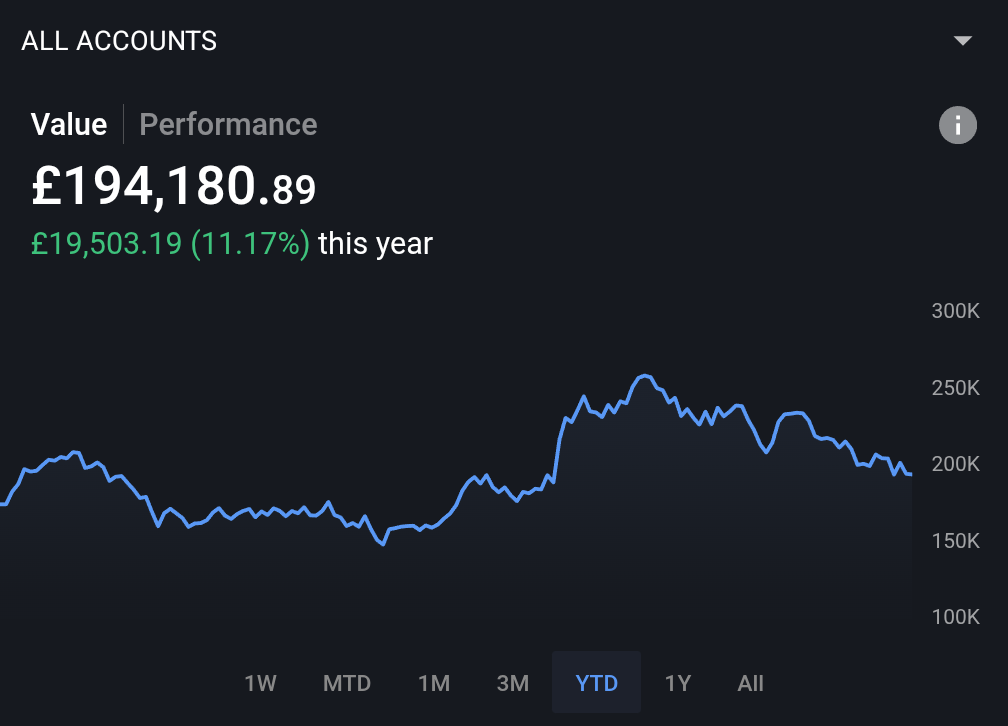
The figures are from my IBKR prior-business-day-close snapshot for 31 July 2026. They are a dated record, not live prices or a recommendation for anyone to copy my allocation.

Portfolio snapshot

At the 31 July close, the IBKR ISA was worth £194,538.84, including £49.84 of cash. The invested value was £194,489.00.

The separate Trading 212 challenge was worth £12,132.13 at its 31 July snapshot, including £136.74 cash. I am keeping it separate because the two accounts use different reporting timings and serve different purposes.

The main portfolio remains deliberately growth-oriented and concentrated. That is not a claim that concentration is safe. It is an acknowledgement that my returns, good or bad, will be shaped heavily by a relatively small number of positions.

Biggest changes in July

The biggest decision was increasing my Rocket Lab position from 1,000 to 2,000 shares. To fund that change, I sold Apple, Alphabet, NVIDIA and SoFi, and reduced Uber in the IBKR ISA. I wrote separately about why I made Rocket Lab roughly 50% of my portfolio, including the concentration, financing and execution risks I am accepting.

I also increased Micron from eight to 10 shares and Surf Air Mobility from 10,000 to 13,800 shares. These are material changes to a concentrated portfolio, so I want them recorded rather than quietly absorbed into an evergreen holdings page.

No quantity changes were identified in the Trading 212 challenge between its late-July reporting snapshots. Its three holdings at month-end were Uber, Amkor and AST SpaceMobile.

Current main holdings at month-end

At the 31 July IBKR close, the core positions included:

  • Rocket Lab: 2,000 shares at $64.95.
  • Palantir: 250 shares at $123.06.
  • AbCellera: 3,001 shares at $5.71.
  • BETA Technologies: 1,000 shares at $18.93.
  • ServiceNow: 150 shares at $111.23.
  • Surf Air Mobility: 13,800 shares at $0.76.

Those prices are the values in the dated broker snapshot. The live Portfolio page is the better place for the latest IBKR ISA holdings and indicative GBP values.

What I am watching

Rocket Lab remains the central position to watch, partly because of its size and partly because the investment case depends on execution continuing across several moving parts. The opportunity is why I own it. The concentration is why I need to keep looking for evidence that could challenge my view.

I am also watching whether the smaller positions continue to earn their place. Owning a company is not a permanent vote of confidence. I need to be able to explain what I am underwriting, what has changed and what would cause me to reassess.

For AbCellera in particular, the clinical proof points remain important. My latest AbCellera investment update sets out why the next programme milestones matter to the thesis.

Where I could be wrong

The obvious risk is concentration. A few disappointing outcomes at the same time would hurt this portfolio materially. That is especially true when growth companies can be volatile, funding needs can change and expectations move faster than the underlying businesses.

Another risk is confusing familiarity with understanding. Spending time researching a company can improve a thesis, but it can also make a view feel more comfortable than it deserves. The job is to keep testing the assumptions, not just to keep repeating them.

Finally, a positive month-end snapshot does not settle anything. I want the monthly record to show the decisions, the uncertainty and the areas where I could be wrong, rather than turn every portfolio move into a victory lap.

Final thoughts

July made the main portfolio simpler in one sense and riskier in another. I have fewer positions that matter, and more exposure to the ideas I believe in most. The trade-off is that I need to be more disciplined about reassessment when the screen is red as well as when it is green.

This is a personal portfolio record, not financial advice. The positions, prices and weights can change after the reporting date.
NVIDIA (NVDA) Investment Thesis: Scale, Execution and Earnings Power

This is my current investment thesis, not financial advice. I own NVIDIA in my main portfolio and the position can change.

The reason I continue to own NVIDIA is not simply that AI is a large theme. It is that NVIDIA has repeatedly shown an ability to turn a technological lead into an operating machine: products that customers want, supply that has to be coordinated at extraordinary scale, and earnings power that follows when the company executes.

That is the heart of my bull case. The next few years will not be decided by whether AI matters. They will be decided by which businesses can keep delivering the computing, networking and systems customers need as the buildout becomes more demanding.

Execution at a scale that is hard to ignore

NVIDIA’s latest quarterly filing illustrates the scale of the current opportunity. For the quarter ended 26 April 2026, the company reported revenue of $81.6 billion, up 85.2% year on year. Net income was $58.3 billion, compared with $18.8 billion in the comparable prior-year quarter.

Numbers at that level can make a thesis look obvious after the event. They are not. The reason they matter to me is that they reflect execution across a difficult chain: silicon design, manufacturing capacity, memory, networking, systems integration, customer deployment and software support. It is one thing to make a fast chip. It is another to help customers build and operate AI infrastructure at enormous scale.

More than a GPU supplier

I do not see NVIDIA purely as a seller of individual GPUs. The company’s position is strengthened by the wider stack around accelerated computing: systems, high-speed networking and the CUDA software ecosystem that many developers and organisations already use.

That does not mean customers cannot change suppliers. They can, and they will keep trying to improve economics. But moving a serious AI workload is not always as simple as comparing the headline price of two chips. Software tools, developer familiarity, model performance, networking and the operational cost of changing a production environment all matter.

The bull case is not that NVIDIA wins every AI workload forever. It is that its scale and execution keep it central to the most important workloads long enough for the earnings power to compound.

The architecture cycle is part of the thesis

One of the reasons I find NVIDIA interesting is the cadence of the platform cycle. Customers are not just making a one-off purchase. They are trying to build capacity for models, inference, agents and applications that are changing quickly. If NVIDIA can keep making each generation valuable enough to justify upgrades, the opportunity is larger than a single hardware refresh.

The company’s supply commitments show how much planning this requires. As of 26 April 2026, NVIDIA disclosed $119 billion of supplier commitments, with most expected to be paid during fiscal 2027. That is not proof of future demand, and it increases the importance of execution. It does show the physical scale behind the AI buildout.

What could challenge the thesis

  • Demand digestion: customers may pause after a period of exceptionally heavy infrastructure spending.
  • Competition and custom silicon: hyperscalers, AMD and other suppliers have strong incentives to reduce dependency and improve their own economics.
  • Export controls and China: policy can affect which products can be sold and where future growth comes from.
  • Infrastructure constraints: data-centre capacity, power and customer financing all matter. Demand for chips alone is not enough if the wider buildout stalls.
  • Expectations: a company producing exceptional results can still be a poor investment if the valuation assumes too much perfection.

My current view

I own NVDA because I think its scale, product execution and ability to turn an AI infrastructure cycle into earnings are still unusual. The growth is already visible. The investment question is whether the company can maintain its central role as customers become more sophisticated, competitors improve and the market starts to separate durable demand from short-term enthusiasm.

I will keep watching revenue quality, gross margins, customer spending behaviour, platform transitions and the willingness of customers to build around NVIDIA’s broader stack. The thesis is strong, but it is not a reason to ignore the price paid or the risk that this cycle eventually slows.

For the wider context, see my current portfolio. The financial figures cited above come from NVIDIA’s Q1 fiscal 2027 Form 10-Q.