

BETA Technologies (BETA) Investment Thesis: Aircraft, Charging and Commercial Validation

This is my current investment thesis, not financial advice. I own BETA Technologies in my main portfolio and the position can change.

BETA Technologies is not a conventional aerospace investment. It is still early in commercialisation, still loss-making and still dependent on certification and execution. That is exactly why the opportunity is interesting to me. The company is trying to turn electric aviation from a promising concept into an operating system of aircraft, charging and manufacturing.

The part of the thesis I find most compelling is not simply vertical take-off aircraft. It is BETA’s ability to build relationships around the conventional take-off ALIA variant, where payload and practical operations may offer a clearer route into early commercial use. The charging ecosystem is equally important. Aircraft without dependable infrastructure are much harder to deploy at scale.

A more practical route into electric aviation

BETA is developing the ALIA in both conventional take-off and landing, or CTOL, and vertical take-off and landing, or VTOL, configurations. The conventional variant matters to me because it can address real logistics and regional-aviation use cases without asking operators to solve every part of the VTOL challenge on day one.

A useful payload and straightforward airport operations can make the first customer conversations more concrete. Rather than selling a distant vision of urban air mobility, BETA can work with operators that have existing routes, maintenance needs and infrastructure decisions to make now.

BETA’s own product site states a demonstrated range of 336 nautical miles, cargo capacity of 200 cubic feet and charge times of under one hour. These are company-reported figures, not guarantees of commercial economics. They do, however, show why the ALIA has a different feel from a purely conceptual eVTOL programme.

The charging ecosystem is part of the product

The aircraft is the visible part of the story. The more important question may be whether BETA can help customers operate a fleet. Its Charge Cube infrastructure, manufacturing capability and focus on deployment create the possibility of a more integrated proposition.

That matters because early electric aviation cannot rely on a fully built public network appearing by itself. Operators need aircraft, charging, maintenance, locations and a credible pathway through certification. If BETA can make those pieces work together, it may reduce the friction that slows adoption for everyone else.

The bull case is not simply that electric aircraft will exist. It is that BETA can make electric flight practical enough for real operators to introduce it before the wider market catches up.

Commercial and defence validation

Early relationships matter in a business like this. BETA’s website says it has an established customer base and more than 800 aircraft in backlog. I would not treat all of that as equivalent to firm, funded deliveries. The distinction between orders, options, deposits and delivered aircraft matters enormously.

There are more tangible points to watch. In March 2026, BETA announced that Surf Air Mobility had placed a firm order for 25 ALIA aircraft, with options for up to 75 more. The company also points to defence engagements and partner relationships. These do not remove the execution risk, but they are evidence that serious operators are engaging with the platform.

The financial reality

This remains a venture-style aerospace investment, even as a public company. In Q1 2026, BETA reported revenue of $10.1 million, a net loss of $122.3 million and cash of $1.59 billion. That cash balance provides time, but the company still needs to deliver against certification, production and customer milestones before it can demonstrate a self-sustaining commercial model.

What could break the thesis

  • Certification delay: timelines can slip, and aviation approvals are not a formality.
  • Production execution: building a few aircraft and manufacturing reliably at scale are different challenges.
  • Order quality: backlog, options and partnership announcements must turn into funded deliveries.
  • Cash burn and dilution: commercialisation takes time and capital.
  • Infrastructure adoption: charging only becomes a moat if customers actually deploy and use it.

My current view

I own BETA because it appears to be building a practical entry point into electric aviation, not just an aircraft for a future market. The CTOL variant, useful payload, customer relationships and charging infrastructure are the pieces I think could matter most.

I will be watching certification progress, firm deliveries, operator utilisation, charging deployments and the cash runway. This is a high-risk position. The upside depends on BETA proving that the aircraft, infrastructure and customer economics can work together in the real world.

For the wider context, see my current portfolio. The financial figures cited above come from BETA’s Q1 2026 Form 10-Q. Product specifications and partnership information are from BETA Technologies.
NVIDIA (NVDA) Investment Thesis: Scale, Execution and Earnings Power

This is my current investment thesis, not financial advice. I own NVIDIA in my main portfolio and the position can change.

The reason I continue to own NVIDIA is not simply that AI is a large theme. It is that NVIDIA has repeatedly shown an ability to turn a technological lead into an operating machine: products that customers want, supply that has to be coordinated at extraordinary scale, and earnings power that follows when the company executes.

That is the heart of my bull case. The next few years will not be decided by whether AI matters. They will be decided by which businesses can keep delivering the computing, networking and systems customers need as the buildout becomes more demanding.

Execution at a scale that is hard to ignore

NVIDIA’s latest quarterly filing illustrates the scale of the current opportunity. For the quarter ended 26 April 2026, the company reported revenue of $81.6 billion, up 85.2% year on year. Net income was $58.3 billion, compared with $18.8 billion in the comparable prior-year quarter.

Numbers at that level can make a thesis look obvious after the event. They are not. The reason they matter to me is that they reflect execution across a difficult chain: silicon design, manufacturing capacity, memory, networking, systems integration, customer deployment and software support. It is one thing to make a fast chip. It is another to help customers build and operate AI infrastructure at enormous scale.

More than a GPU supplier

I do not see NVIDIA purely as a seller of individual GPUs. The company’s position is strengthened by the wider stack around accelerated computing: systems, high-speed networking and the CUDA software ecosystem that many developers and organisations already use.

That does not mean customers cannot change suppliers. They can, and they will keep trying to improve economics. But moving a serious AI workload is not always as simple as comparing the headline price of two chips. Software tools, developer familiarity, model performance, networking and the operational cost of changing a production environment all matter.

The bull case is not that NVIDIA wins every AI workload forever. It is that its scale and execution keep it central to the most important workloads long enough for the earnings power to compound.

The architecture cycle is part of the thesis

One of the reasons I find NVIDIA interesting is the cadence of the platform cycle. Customers are not just making a one-off purchase. They are trying to build capacity for models, inference, agents and applications that are changing quickly. If NVIDIA can keep making each generation valuable enough to justify upgrades, the opportunity is larger than a single hardware refresh.

The company’s supply commitments show how much planning this requires. As of 26 April 2026, NVIDIA disclosed $119 billion of supplier commitments, with most expected to be paid during fiscal 2027. That is not proof of future demand, and it increases the importance of execution. It does show the physical scale behind the AI buildout.

What could challenge the thesis

  • Demand digestion: customers may pause after a period of exceptionally heavy infrastructure spending.
  • Competition and custom silicon: hyperscalers, AMD and other suppliers have strong incentives to reduce dependency and improve their own economics.
  • Export controls and China: policy can affect which products can be sold and where future growth comes from.
  • Infrastructure constraints: data-centre capacity, power and customer financing all matter. Demand for chips alone is not enough if the wider buildout stalls.
  • Expectations: a company producing exceptional results can still be a poor investment if the valuation assumes too much perfection.

My current view

I own NVDA because I think its scale, product execution and ability to turn an AI infrastructure cycle into earnings are still unusual. The growth is already visible. The investment question is whether the company can maintain its central role as customers become more sophisticated, competitors improve and the market starts to separate durable demand from short-term enthusiasm.

I will keep watching revenue quality, gross margins, customer spending behaviour, platform transitions and the willingness of customers to build around NVIDIA’s broader stack. The thesis is strong, but it is not a reason to ignore the price paid or the risk that this cycle eventually slows.

For the wider context, see my current portfolio. The financial figures cited above come from NVIDIA’s Q1 fiscal 2027 Form 10-Q.

Palantir (PLTR) Investment Thesis: Why AIP Commercial Adoption Matters Most

This is my current investment thesis, not financial advice. I own Palantir in my main portfolio and the position can change.

My interest in Palantir is not simply that it is an AI company. There are plenty of companies that can claim that label. The question I find more interesting is whether Palantir’s Artificial Intelligence Platform, or AIP, can become durable commercial infrastructure inside large organisations.

That is the part of the bull case I care about most. If AIP is helping customers move from experimentation into real workflows, it has a chance to become more than an AI feature or a short-lived spending cycle. It could become a platform that sits underneath important decisions, operations and automation.

The commercial adoption question

Palantir’s latest filed quarterly results give the thesis some substance. For the three months ended 31 March 2026, the company reported total revenue of $1.63 billion, compared with $884 million in the comparable period a year earlier. Commercial revenue was $774 million, up from $397 million.

Those numbers alone do not prove a long-term moat. Fast growth can attract a lot of attention, and it can make any valuation look more forgiving than it really is. But they do suggest that the commercial story is no longer just an aspirational slide in an investor presentation.

For me, the key question is what customers are actually buying. If they are mainly paying for short pilots and AI enthusiasm, the revenue can fade when budgets tighten. If they are using AIP to connect data, people and workflows in ways that are difficult to remove, the economics could be very different.

Why AIP could matter

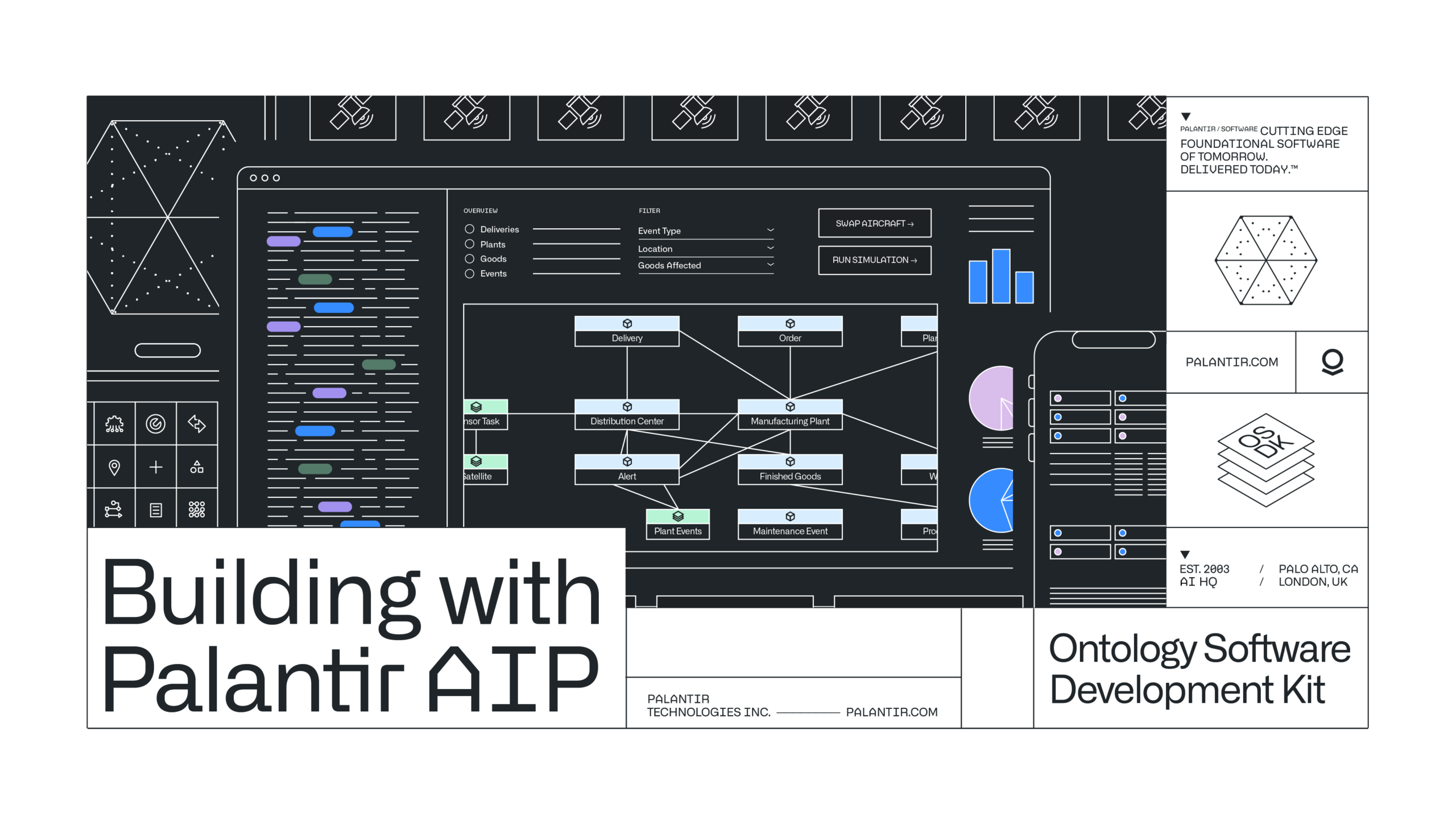
Palantir describes AIP as a platform that connects large language models to an organisation’s data, permissions, workflows, agents and governance. That matters because most companies do not need another chatbot. They need a way to use AI in real operating environments without losing control of their data or creating unmanageable risk.

The potential appeal is that Palantir already has the components around the model layer. Foundry helps organisations map and work with data, the Ontology gives that data operational context, and Apollo supports deployment across complex environments. If those pieces work together in practice, AIP can be more useful than a standalone model interface.

The bull case is not that every company will buy more AI software. It is that a smaller number of important customers will build Palantir into workflows they do not want to unwind.

What I would watch from here

  • Commercial growth quality: whether growth remains strong as deployments mature, rather than relying on a small number of highly visible wins.
  • Customer depth: whether customers expand from pilots into repeatable, material programmes.
  • Operating leverage: whether revenue growth continues to translate into disciplined profitability and cash generation.
  • Remaining performance obligations: the company reported $4.5 billion at the end of Q1 2026, which is useful context, but not the same thing as recognised revenue.

The risks I do not want to ignore

The valuation risk is obvious. A business priced for exceptional execution leaves little room for disappointment. Commercial growth slowing, customers choosing cheaper or more open alternatives, or the market deciding that AI budgets were pulled forward would all challenge the thesis.

I also keep an eye on stock-based compensation. Palantir recorded $202 million in stock-based compensation in Q1 2026. That does not invalidate the business, but it matters when judging how much of the reported progress ultimately belongs to shareholders.

There is also a genuine execution question. Palantir operates in competitive markets and has to prove that its platform can scale commercially without becoming too dependent on a narrow group of customers or on an unusually favourable AI spending environment.

My current view

I own PLTR because I think AIP has a credible path to becoming operational software rather than a superficial AI add-on. The commercial growth is encouraging, but the enduring thesis depends on adoption becoming deeper and stickier over time.

This is therefore a thesis I want to revisit through customer expansion, commercial durability, margins and the valuation the market is asking me to pay. I am not assuming the outcome. I am watching for evidence that the platform is becoming harder to replace as it becomes more embedded.

For context on how this fits into the wider picture, see my current portfolio. The financial figures cited above come from Palantir’s Q1 2026 Form 10-Q.

What Financial Independence Actually Feels Like (So Far)

Financial independence is often described in spreadsheets.

People talk about net worth milestones, savings rates, withdrawal percentages, and the age they want to stop working. All of that matters. The numbers matter. But I think the emotional side of financial independence gets talked about far less, even though that is the part you actually live day to day.

So far, financial independence has not felt like one dramatic moment. It has felt more like a slow change in how much tension I carry.

It feels quieter than I expected

The biggest surprise for me is that progress towards financial independence does not feel exciting most of the time. It feels quieter than that. It feels like less background noise.

You stop panicking quite so quickly. You stop feeling like every setback is a crisis. You start making decisions with a little more space between the event and your reaction.

That space matters more than I expected. It is easy to think financial freedom will feel like winning. In reality, at least so far, it often feels more like having a little more room to breathe.

It feels practical, not glamorous

One thing I have learned is that financial independence rarely looks impressive from the outside. A lot of it is repetitive, slightly boring behaviour done consistently over time.

It is not usually a dramatic lifestyle. It is choosing resilience over appearance. It is building cash reserves, continuing to invest, and trying not to let short term emotion dictate long term decisions. That is part of why I wrote Why I Stopped Buying Things to Look Successful. The journey has made me value security far more than signalling.

That shift has probably been one of the most meaningful parts of it. You start to care less about looking like you have made it, and more about whether your life is actually becoming more stable, more flexible, and more your own.

It feels good, but not in a perfect way

There are real positives. More optionality. Less desperation. A growing sense that your time does not have to be sold in quite the same way forever. Even before full financial independence, that change in mindset can be deeply valuable.

But there are also things I did not expect.

Progress can feel strangely anticlimactic. You imagine that hitting a certain number will change everything, but most of the time you still wake up as yourself, with the same habits, worries, and unanswered questions. Financial progress solves some problems, but it does not magically give you an identity or a sense of purpose.

It can also create distance between you and other people. Money is still a difficult subject for many people to talk about honestly. The further you go down this path, the more you realise that financial independence is not just a maths problem. It is also a social and psychological one.

What it feels like day to day

Day to day, I would describe it like this:

  • less fear around unexpected costs
  • more patience when markets are volatile
  • more confidence in saying no to things that do not matter
  • more awareness that freedom is built gradually, not claimed all at once

That last point matters. I think people sometimes imagine financial independence as a finish line. I am starting to think it feels more like a spectrum. Every step towards it changes your life a little before you ever fully arrive.

You can see some of that thinking in how I approach my Investment Portfolio. For me, investing is not just about chasing returns. It is about building a life with more room, more choice, and less financial fragility.

The challenge nobody really mentions

One subtle challenge is that once money becomes less chaotic, you are left with bigger questions. What do you actually want your days to look like? What matters when survival is not dominating every decision? What kind of work would you choose if you had more choice?

That is the part of financial independence I think gets underplayed. It is not only about escaping pressure. It is also about becoming responsible for your own direction.

That can feel empowering, but it can also feel uncomfortable. Sometimes the structure you want to leave behind is also the structure that has been organising your life.

So what does it actually feel like?

So far, it feels calmer, slower, and more real than I expected.

It feels less like a victory lap and more like gradually removing sources of pressure. It feels less like luxury and more like relief. It feels less like having everything figured out and more like having a better foundation to figure things out from.

That might sound less dramatic than the usual version of financial freedom, but to me it is far more appealing. I am not really chasing a flashy end point. I am chasing a life that feels steadier and more intentional.

If you are on a similar path, I would suggest paying attention not just to the numbers, but to what is changing in your head and in your daily life. That is where a lot of the real value shows up first.


If you want more of the real-time version of this journey, you can follow me on X. If you want more practical reading, Wealth Resources includes a few of the UK sources I rate, including Monevator and MoneySavingExpert.

Related reading

Why I Stopped Buying Things to Look Successful

For a long time, I thought a better-looking life was the same thing as a better life.

I never said that out loud. But if I’m honest, a lot of my early spending decisions had very little to do with building wealth and everything to do with looking like I was. I told myself I was making “smart choices” or “rewarding hard work,” when in reality I was often just buying approval dressed up as ambition.

The Purchase That Changed My Thinking

One example still makes me wince. I once spent a significant amount on something mainly because it looked like the kind of thing successful people owned. It photographed well. It sent the right signals.

The problem was that nobody was really paying attention, not in any meaningful way. The purchase gave me a short burst of satisfaction, then quietly became just another thing I owned. It had not made me freer, safer, or more resilient. It had simply made me look the part.

The Realisation

The shift happened gradually. I started noticing what actually reduced stress in my life versus what simply impressed people for a few seconds. Having a cash buffer mattered more than having something flashy. Systems that saved me time and mental energy mattered more than possessions that photographed well.

That was the moment financial security started to feel more valuable to me than looking rich. Not in a preachy way, but in a very practical sense: security compounds. Status doesn’t.

Man sitting thoughtfully at a desk by a window, reflecting

How I Spend Differently Now

These days, before buying something, I ask a simple question: does this improve my freedom, my time, or my resilience? If the honest answer is no, I’m far less interested than I used to be.

That mindset shows up in a few consistent ways:

  • I prioritise cash flow and investing over visible upgrades.
  • I choose fewer, more useful purchases over frequent status-driven ones.
  • I actively resist lifestyle inflation as my income grows.
  • I ask whether a purchase buys me optionality, not just admiration.

There’s something quietly liberating about accepting that most people are too busy managing their own lives to notice or care what car you drive or what’s sitting on your desk.

Being Rich vs Looking Rich

The core lesson for me is simple: being rich and looking rich are not the same thing. One is visible. The other is useful.

Looking rich is a performance. Being secure is a position. And only one of those actually protects you when things go wrong.

The Takeaway

If you’re in that phase where spending feels tied to proving something, you’re not alone. Most people go through it.

The sooner you shift from spending for status to spending for freedom, the sooner your money starts working for your future instead of your image. That single change in mindset, more than any specific investment, is what actually moves the needle toward long-term financial security.


If you’re on a similar journey, you can follow along on X or explore my Investment Portfolio to see how these principles show up in practice.

Related reading